The financial world is constantly changing as businesses, startups, and investors look for new ways to raise and manage money. Funding plays an important role in this process because it helps businesses develop products, expand operations, introduce new technologies, and compete in different markets. Understanding the latest funding trend rprinvesting can help readers explore how investment priorities are changing and why certain industries are receiving more attention.
In recent years, technology, artificial intelligence, digital infrastructure, and sustainable business solutions have become important areas of investment. However, funding activity does not grow equally across every industry. Some sectors attract large investments, while others experience slower growth because of economic uncertainty, business risks, or changing investor preferences.
According to Crunchbase’s October 2026 report, global venture funding reached approximately $159 billion in the third quarter of 2026. Although this was lower than the previous quarter, it remained higher than the same period in 2025. The report also highlighted strong investment activity in artificial intelligence and related technologies.
What Does Latest Funding Trend RPRInvesting Mean?
Funding trends describe changes in how money moves between investors, businesses, startups, and different industries. These trends help explain which sectors are attracting investment, what financing methods companies are using, and how economic conditions influence funding decisions.
The phrase latest funding trend rprinvesting can be understood as a search topic connecting RPRInvesting with current developments in business financing and investment. The RPRInvesting website has published content about venture capital, impact investing, crowdfunding, and alternative funding sources. However, it is important to understand that this phrase is not an established financial indicator or a recognized investment measurement.
For readers, the main purpose of studying funding trends is to understand how the financial environment is developing. Instead of following every investment announcement, investors can examine broader patterns and compare information from reliable financial reports.
Understanding the Current Funding Landscape
The global funding landscape includes different financing trend rprinvesting activities that help companies start, operate, and expand their businesses. Startups may need early financial support to develop their products, while established companies may seek larger investments to enter new markets or improve their existing operations.
In 2026, global investment activity has shown strong interest in technology-related industries, particularly artificial intelligence infrastructure and semiconductors. However, the distribution of investment remains uneven across sectors and geographical regions.
A useful example comes from KPMG’s Q3 2026 Venture Pulse findings. Its report estimated global venture capital investment at $170.9 billion across 8,341 deals during the third quarter. KPMG also highlighted the concentration of large funding rounds in AI and supporting infrastructure.
How Businesses and Startups Attract Investment
Businesses generally attract funding trend rprinvesting by presenting a clear business model, demonstrating market demand, and explaining how additional capital will support their development.
Investors may examine several factors before providing financial support, including:
- Business model and revenue potential.
- Market size and customer demand.
- Management experience and business strategy.
- Financial records and operating expenses.
- Competitive advantages and growth opportunities.
- Possible risks and expected returns.
Changes in Investor Preferences and Funding Strategies
Investor preferences change as new technologies develop and economic conditions evolve. In some periods, investors may prioritize rapid business expansion, while in others they may focus more heavily on financial stability and sustainable growth. The latest funding trend rprinvesting can be explored through these changing priorities. Recent reports show strong investment interest in AI, robotics, semiconductors, and other strategically important technologies. At the same time, investors are paying attention to the infrastructure and resources needed to support these industries.
Major Factors Influencing Funding Trends
Funding decisions are influenced by several economic, technological, and business-related factors. Understanding these influences helps explain why some companies receive financial support while others face difficulties securing investment.
Economic Conditions and Market Changes
Economic conditions influence how businesses operate and how investors evaluate financial opportunities. Economic growth, consumer demand, employment conditions, and business confidence can all affect investment decisions. When businesses expect stronger demand, they may seek additional funding to expand production, hire employees, and develop new products. On the other hand, uncertainty can encourage investors to become more selective.
International investment can also be affected by trade policies, geopolitical developments, and changes in global supply chains. UNCTAD’s 2026 World Investment Report identifies geopolitical tensions, economic fragmentation, and policy uncertainty as important challenges for international investment.
Interest Rates and Inflation
When borrowing costs increase, companies may find loans more expensive. This can affect expansion plans, equipment purchases, and daily business operations. Higher interest rates can also influence investor preferences because fixed-income investments may become more attractive compared with certain higher-risk opportunities.
The OECD’s Financing SMEs and Entrepreneurs 2026 report explains how inflationary pressures and higher interest rates affected venture capital liquidity and startup valuations in earlier years. It also discusses how restrictive financial conditions influenced investment activity.
Technology and Digital Innovation
Technology is changing how companies develop products, communicate with customers, and attract investors. Artificial intelligence, cloud computing, automation, and digital financial services have created new business opportunitiesfunding trend rprinvesting.
Investors are increasingly examining companies that develop practical technological solutions. For example, AI infrastructure requires data centres, computing capacity, semiconductors, and reliable energy supplies.
Popular Funding Sources and Investment Options
Businesses have access to different financing methods depending on their size, financial needs, ownership structure, and development stage. Each funding source has its own advantages and limitations.
Venture Capital Funding
Venture capital is a type of private investment that provides money to startups and growing companies with significant development potential. Venture capital firms usually invest in exchange for an ownership interest in a business. Along with financial support, some investors provide strategic guidance, industry connections, and business development assistance.
Technology startups often seek venture capital because developing new products and expanding operations can require substantial financial resources. The 2026 venture capital market demonstrates the importance of this funding source. Crunchbase reported that global venture funding reached $679 billion during the first three quarters of 2026, based on its tracking of startup financing activity.
Angel Investors
They may invest when a startup is still developing its product, testing its business model, or building its first customer base. Angel investors can also offer professional experience and valuable industry contacts. However, they generally expect a potential financial return in exchange for taking the risk of investing in a young business. For entrepreneurs, angel investment can provide an alternative to traditional business loans, although it may involve sharing ownership and decision-making influence.
Crowdfunding
Crowdfunding allows businesses or individuals to collect financial contributions from multiple people through online platforms. It can help entrepreneurs introduce new products, test customer interest, and raise money for specific projects.
Different crowdfunding models include:
- Donation-based crowdfunding.
- Reward-based crowdfunding.
- Equity crowdfunding.
- Debt-based crowdfunding.
How Technology Is Changing Funding Trends
Technology is becoming an important part of modern financing because it helps businesses reach investors, manage financial information, and identify new opportunities. Digital tools have also changed how companies communicate their business plans and present investment opportunities.
The Role of Artificial Intelligence in Investment Analysis
Artificial intelligence is increasingly used in financial research, data analysis, risk assessment, and business forecasting. AI-powered tools can help financial professionals organize large amounts of information, identify patterns, and compare different financial scenarios. However, their results still require human judgment because automated systems can produce inaccurate or incomplete conclusions.
Digital Platforms and Online Funding Opportunities
Online platforms have made it possible for businesses to present projects and connect with potential investors beyond their local markets. Depending on the platform and applicable regulations, entrepreneurs may explore crowdfunding, equity financing, and other digital fundraising options. These platforms can simplify communication and provide access to financial information. However, businesses and investors should verify platform legitimacy, understand fees, and review the relevant legal conditions before participating.
How Financial Technology Is Improving Access to Funding
Financial technology, commonly known as fintech, uses digital systems to improve financial services. Examples include online payment systems, digital banking, financial management applications, and technology-supported lending services. These developments can make certain financial processes more convenient for businesses and customers. They can also help smaller companies organize financial records and communicate with potential lenders.
Emerging Industries Attracting Investor Attention
Investment opportunities are not limited to traditional industries. New technologies, changing customer needs, and global development priorities are creating opportunities across several sectors. Understanding these industries is an important part of researching the latest funding trend rprinvesting.
Artificial Intelligence and Technology
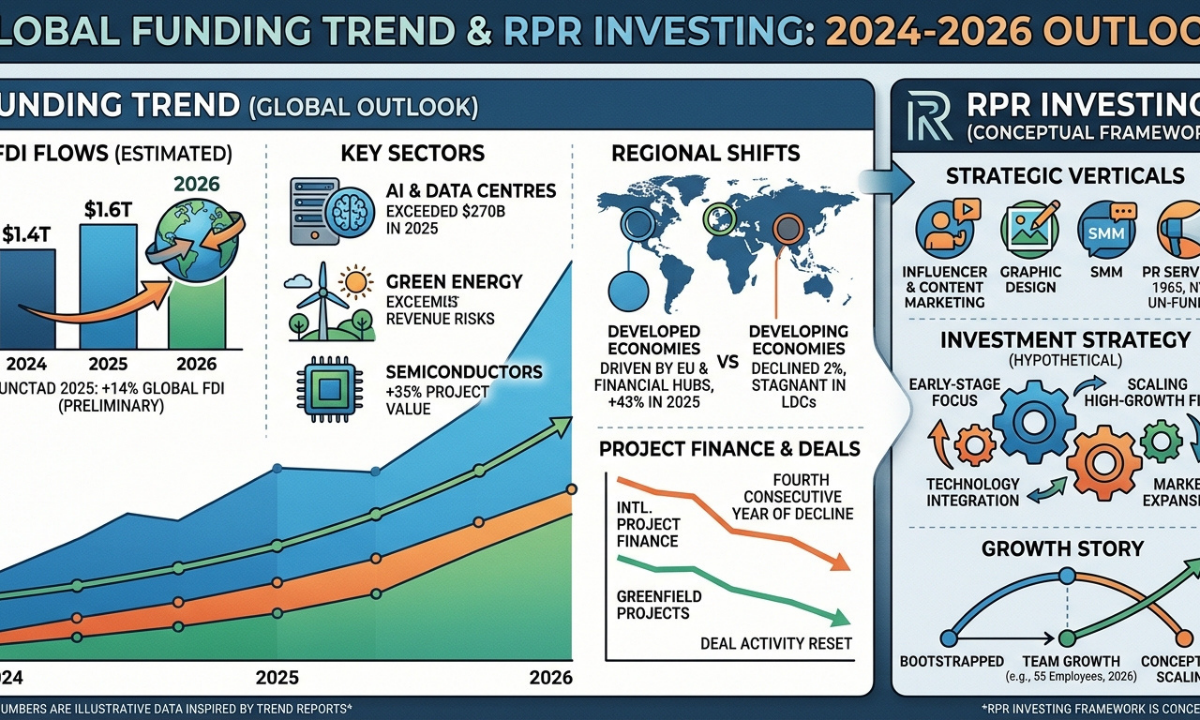
Companies are developing AI software, computing infrastructure, robotics, data management systems, and business automation solutions. Crunchbase reported that AI-driven startups raised approximately $102 billion in Q3 2026, representing around 64% of global venture capital funding tracked in its report. This demonstrates how strongly investment activity was concentrated in AI-related businesses during that quarter.
Renewable Energy and Sustainable Businesses
Renewable energy and sustainable technologies are important areas of long-term business development. Companies working on solar power, wind energy, batteries, electric vehicles, and energy storage may attract investment because of changing energy requirements and environmental objectives.
However, funding activity is not uniform across the entire sector. UNCTAD’s 2026 research identifies energy-transition technologies as a strategic investment area while also reporting uneven international infrastructure investment. This distinction is important because interest in sustainable development does not guarantee that every renewable energy project will receive funding.
Healthcare and Biotechnology
Healthcare and biotechnology continue to attract attention from investors interested in scientific research, medical innovation, and improved healthcare services. Potential areas of development include medical technology, diagnostic tools, biotechnology research, pharmaceutical innovation, and digital healthcare. KPMG’s 2026 venture capital analysis identifies life sciences, biotechnology, and health technology among the sectors attracting investor attention.
Benefits of Following the Latest Funding Trends
Following funding trends can help investors, entrepreneurs, and business owners understand changes in the financial environment. The purpose is not to copy every investment decision made by other people. Instead, it is to use reliable information to understand market developments and make better-informed decisions. Understanding market developments: Funding reports help readers identify industries receiving increased investment and understand how financial priorities are changing.
Risks and Challenges in Modern Funding
Although funding can help businesses grow, obtaining or providing financial support involves several risks. Investors and entrepreneurs should understand these challenges before making financial commitments.
Market Uncertainty and Economic Changes
Financial markets can change because of inflation, interest rates, political developments, trade restrictions, and unexpected economic events. These changes can affect company valuations, borrowing costs, and investment decisions. A business that appears financially strong today may experience difficulties if customer demand falls or operating expenses increase unexpectedly.
Investment Risks and Financial Losses
Every investment involves some level of risk. Startups may fail to achieve their business goals, products may not attract customers, and companies may struggle to generate enough revenue. Venture capital and private equity investments can be particularly uncertain because they involve businesses that may have limited operating histories or unproven business models.
Competition for Funding
Startups may struggle to attract investors if they cannot demonstrate market demand, a clear revenue model, or a competitive advantage. Competition can be particularly challenging for businesses operating in crowded markets where similar products and services are already available.
How to Analyze Funding Trends Before Investing
Understanding funding trends requires more than reading news headlines or following popular investment discussions. Investors should develop a systematic research process and compare information from multiple reliable sources.
Here are some useful steps.
1. Research reliable financial information: Start by reading reports from established research organizations, financial institutions, and relevant regulatory authorities. Sources such as Crunchbase, KPMG, OECD, and UNCTAD can provide information about investment activity, funding patterns, and industry developments.
2. Compare different funding opportunities: Do not focus on only one company or industry. Compare different businesses, financing methods, and market conditions to understand their advantages and limitations.
3. Understand risk levels and investment goals: Every financial opportunity has a different risk profile. Consider your financial goals, investment period, and ability to handle potential losses before making a decision.
4. Review company performance and financial reports: Examine available information about revenue, operating expenses, debt, cash flow, management, and business operations. A company receiving substantial funding is not automatically a profitable or successful business.
Future Outlook for Funding and Investment Trends
The future of funding will likely be influenced by technological innovation, economic conditions, business development, and changing investor expectations. Artificial intelligence is expected to remain an important investment theme because companies continue developing AI applications and the infrastructure needed to support them. Semiconductors, data centres, robotics, and advanced computing may also remain significant areas of business investment.
UNCTAD’s World Investment Report 2026 highlights the growing concentration of international investment in strategic industries. Announced greenfield investment in five strategic sectors increased from $109 billion in 2020 to $576 billion in 2025. These sectors include AI infrastructure, semiconductors, critical minerals, advanced technologies, and energy-transition technologies.
Final Thoughts
Understanding funding developments is important for anyone interested in business growth, entrepreneurship, and financial markets. Investment priorities change as new technologies emerge, economic conditions develop, and businesses search for better ways to raise capital. The latest funding trend rprinvesting offers a useful starting point for exploring venture capital, alternative financing, digital innovation, and emerging industries. Recent 2026 reports show considerable investment activity in artificial intelligence, semiconductors, data centres, and other strategic technologies. However, funding remains uneven across different industries and regions.
FAQs
Q1. What is the latest funding trend RPRInvesting?
Ans: The latest funding trend rprinvesting explores changes in business financing, venture capital, and investment activity. Major 2026 investment themes include AI, digital infrastructure, and advanced technologies.
Q2. Why are funding trends important for investors?
Ans: Funding trends help investors understand market changes, emerging industries, and new business opportunities. They also support better research and informed financial decisions.
Q3. What industries are attracting the most funding?
Ans: Artificial intelligence, semiconductors, data centres, robotics, and advanced technologies are attracting significant investor attention. Healthcare and renewable energy are also important sectors.
Q4. How does technology influence modern funding?
Ans: Technology helps businesses connect with investors and access digital financing opportunities. AI tools also support financial research, data analysis, and investment planning.
Q5. What are the most common sources of business funding?
Ans: Common funding sources include venture capital, angel investors, crowdfunding, private equity, and bank loans. Each option has different costs, requirements, and ownership conditions.