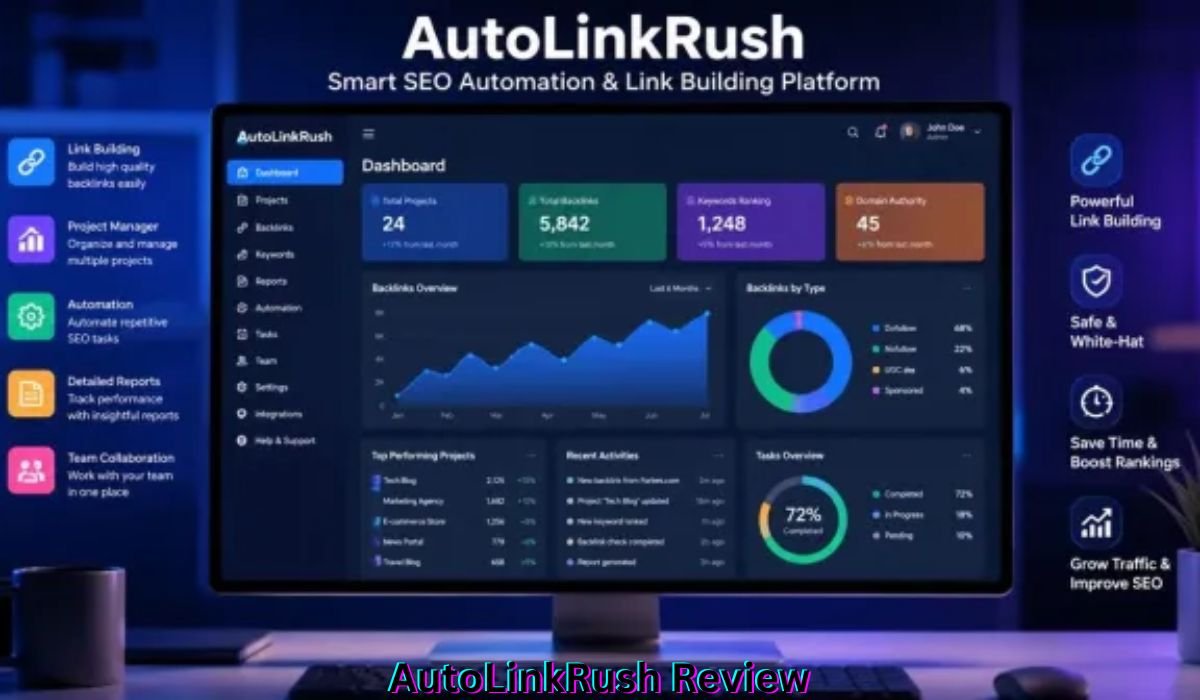
This AutoLinkRush Review explains what the tool really does when you hand it a URL and a keyword. Instead of repeating big promises, we look at how automated backlinks work, what they can realistically offer, and where SEO risks quietly begin for website owners who want honest answers.
Think of this AutoLinkRush Review as a friendly walkthrough. We cover pricing confusion, link quality, indexing, and measurement in plain language, so you can decide whether this backlink generation tool fits your goals, budget, and risk tolerance before spending a dollar. Let’s dive in together.
What Is AutoLinkRush, and What Does It Actually Offer?
What AutoLinkRush Says Its Service Does
AutoLinkRush promotes itself as an automated SEO service built around URL submission and keyword submission. You enter details once, and the system spreads them across an external source network. It sounds easy, but the advertised volume describes opportunities, not guaranteed quality.
- Starts with your target URL and target keyword
- Promotes large backlink quantities
Why It Combines URL Submission With Backlink Generation
Many automated tools blend URL distribution, ping services, and directory submissions into one workflow. The idea is to help pages get noticed while also creating references. That combination is convenient, though discovery and link authority are different things, and people often mix them up.
- Covers URL discovery and link generation
- Convenient, but not automatically authoritative
What Kind of SEO Service You Are Actually Looking At
Think of it as an SEO automation shortcut, not a full SEO strategy. It doesn’t research publishers, pitch editors, or earn editorial backlinks. It handles one narrow job, so you still need content, technical fixes, and internal linking for real results.
- A tool, not a complete agency
- Doesn’t replace content marketing
| Feature | AutoLinkRush-Style Tools | Manual Link Building |
| Speed | Fast | Slow |
| Link Type | Automated | Editorial |
| Relevance | Often broad | Highly targeted |
| Effort | Low | High |
How Does AutoLinkRush Turn a URL and Keyword Into Backlink Submissions?

Adding the URL You Want to Promote
The first input is your target webpage. It can be a homepage, product page, or article. Submitting a specific page lets you judge results fairly later, because you know exactly which public webpage was supposed to benefit from the campaign.
- Use a publicly accessible URL
- Pick one clear page per test
Choosing a Keyword for the Submission
The keyword gives the submission some context, such as “home workout routines” for a fitness article. But it isn’t a ranking promise. Typing a target keyword doesn’t force Google to rank your page, because search intent and link context still decide the outcome.
- Choose a phrase matching page relevance
- Avoid overly commercial anchor text
Starting the Automated Submission Process
Once you submit, the system handles automated distribution for you. That saves hours compared with registering on individual sites. The tradeoff is control: you rely on the service’s backlink sources, so source quality becomes the biggest factor behind whatever value you receive.
- Convenient, hands-off workflow
- Less control over link placement
What the Service Claims Happens After Submission
Marketing focuses on backlink generation from many sources. In practice, several different outcomes can happen: a reference appears, a link is clickable, Google discovers it, the page gets indexed, or nothing meaningful changes. Each step is separate and uncertain.
- A reference isn’t a ranking
- Check each stage separately
Are the “1,000+ Backlinks” Really 1,000 Valuable SEO Links?
Why Generated URLs and Valuable Backlinks Are Not the Same Thing
A link inside a respected, topic-related article is a recommendation. A link on a crowded submission page full of unrelated URLs is just a listing. Both exist, but they don’t carry equal SEO value. Big numbers can hide low-quality backlinks.
- Natural backlinks carry context
- Bulk backlinks often lack it
How Ping, Directory, Bookmark, and Other Submission Links Differ
Each submission type does something different. Pings announce a URL, directory-style listings categorize it, and bookmark-style pages publish another reference. None equals an editorial mention, where a publisher chooses your content. Treating them as identical leads to unrealistic expectations.
- Pings help discovery
- Editorial links build authority
| Link Type | Main Purpose | Authority Level |
| Ping | Discovery | Very low |
| Directory | Listing | Low |
| Bookmark | Public reference | Low |
| Editorial | Recommendation | High |
What Makes a Backlink Useful Beyond Simply Existing
Ask whether the linking site is relevant, whether the page is indexable, and whether the link sits in useful content. A good link makes sense to a human reader. If it looks mechanically generated, its link quality is probably limited.
- Check contextual relevance
- Look at link attributes
Can AutoLinkRush Get Your Page Indexed, or Are You Expecting a Ranking Boost?
What Crawling, Discovery, and Indexing Actually Mean
Google first discovers a URL, then crawls it, then decides whether to include it in its index. Ranking comes last. Search engine crawling and Google indexing are separate steps, so an external reference helps at most with the first one.
- Discovery comes first
- Ranking comes last
Why Getting a URL Discovered Does Not Guarantee Indexing
Even when Google finds your URL elsewhere, it may skip it. Thin content, duplicate content, a wrong canonical URL, or a noindex directive can block inclusion. More links won’t fix those technical indexing issues, so diagnose the real cause first.
- Check robots configuration
- Review canonicalization
Why Indexing Still Does Not Mean Higher Rankings
An indexed page can still get almost no traffic. Competing pages may be more useful or better matched to searcher intent. So if your page appears in Google after a campaign, that alone doesn’t prove the links caused any ranking improvements.
- Indexed doesn’t mean visible
- Compare against competitor performance
Where AutoLinkRush Fits Into That Process
It sits near the URL discovery and external-link stage. It can’t promise indexing, and indexing can’t promise rankings. If you only want faster discovery, judge it differently than if you want strong SEO authority for a competitive keyword.
- Match the tool to the goal
- Never expect guarantees
| Stage | Meaning | Guaranteed? |
| Discovery | Google finds URL | No |
| Crawling | Page is fetched | No |
| Indexing | Page enters index | No |
| Ranking | Page appears for queries | No |
What Makes AutoLinkRush Backlinks Risky for Some Websites?
How Automated Links Can Become a Search-Spam Concern
Automation isn’t the problem; the pattern is. Repetitive, irrelevant, large-scale links can look like link manipulation to search engine algorithms. Google’s policies target links created mainly to influence rankings, so judge the actual links, not the label “automated.”
- Watch for artificial link patterns
- Repetition raises SEO risks
Why Keyword-Rich, Paid, and Sitewide Links Need Context
Descriptive anchors aren’t automatically bad, but the same keyword-rich anchor text repeated across unrelated sites looks unnatural. Sitewide links and paid links also deserve scrutiny, because they differ greatly from one contextual mention inside a relevant article.
- Vary your anchor-text patterns
- Check link placement carefully
Why Do-Follow Link Placements Deserve Extra Attention
“Do-follow backlinks” sound valuable, yet followed status alone proves nothing. A poor page with a followed link is still a poor page. Source quality, relevance, and placement matter more than the technical attribute that marketers love to highlight.
- Followed doesn’t mean strong
- Judge the linking-page quality
Why an Established or Client Website Requires More Caution
A small test site can absorb mistakes. A busy ecommerce store or client website can’t. The cost of a questionable link profile may far exceed the service fee, so the importance of the site should decide how boldly you experiment.
- Protect established websites
- Test on low-stakes websites first
Why Do AutoLinkRush’s Public Pricing and Backlink Limits Conflict?
What the Homepage Currently Advertises
The homepage promotes high backlink allowances, including claims in the thousands. That makes the service look like a heavy-duty link-building tool. But headline numbers on a homepage advertisement should be compared with the detailed plan information before you trust them.
- Large advertised backlink quantities
- Not necessarily plan-specific
What the Dedicated Pricing Page Currently Lists
The dedicated pricing page describes backlink limits differently from the homepage. A buyer could easily see the bigger number, assume it applies to every plan, and later discover the actual package limits are lower. This pricing inconsistency deserves attention.
- Numbers don’t match across pages
- Treat conflicts as unconfirmed
Why the Different Backlink Numbers Matter to a Buyer
Backlink quantity is the main reason people buy such services. If one page suggests thousands and another lists far fewer, the cost-benefit analysis changes completely. Different wording might describe sources versus placements, but unclear pricing transparency leaves buyers guessing.
- Affects package value
- Changes your ROI math
What the Pricing Information Still Leaves Unclear
Several questions remain open, and you should get answers before paying. Without clear confirmation, never treat the advertised count as guaranteed backlinks or assume every placement is permanent or equal in quality.
- Per-URL, per-campaign, or account limits?
- Guaranteed or potential submissions?
| Question to Ask | Why It Matters |
| Limit per URL or account? | Affects total value |
| Guaranteed placements? | Sets expectations |
| Permanent links? | Impacts link permanence |
| Free vs paid differences? | Clarifies upgrades |
Where Are AutoLinkRush’s Links Placed, and What Does That Tell You About Their Value?
What the Public List of Linking Websites Shows
A public source list reveals the link environment you’re entering. If it spans many industries and languages, the system favors broad distribution over specialized outreach. That’s a clue that topical relevance may be weak for your page.
- Review linking website examples
- Look for subject-area relevance
Why Relevance Matters When Evaluating a Link
Picture an accounting software article linked from a business technology blog. That makes sense. Now picture it sitting beside gaming and random listings. The link exists, but its meaning is far weaker, and contextual backlinks simply carry more weight.
- Relevant sites help
- Random sites dilute value
Why Domain Authority Alone Cannot Prove Link Quality
Domain Authority and Domain Rating are handy research numbers, not proof of quality. A high-score site can host a neglected, outbound-link-stuffed page, while a modest site may publish excellent content. Evaluate the specific page, not just the domain score.
- Scores are third-party SEO metrics
- Inspect the actual page
How Placement, Indexability, and Link Attributes Change the Picture
Look at several traits together. A link that is live, relevant, indexable, and naturally placed sends a very different signal than one buried on a low-context page. Checking linking-page indexability and link attributes gives you a truer picture than totals.
- Is the page crawlable?
- Does it have excessive outbound links?
How Can You Tell Whether AutoLinkRush Produced a Useful Result?
Start With the Actual Links Instead of the Reported Number
Never judge a campaign by the provider’s report alone. Use a backlink analysis tool to view real referring domains and inspect representative backlink samples. Look for patterns: unrelated domains, similar-looking pages, and repeated anchor text often reveal how broadly links were generated.
- Run a backlink audit
- Spot repeated anchors
Separate Live, Indexed, Relevant, and Followed Links
These terms aren’t synonyms. A live link exists on the page, an indexed page is in Google, a relevant link fits your topic, and a followed link has a technical attribute. Many campaigns produce plenty of links but few that satisfy all four.
- Count only links meeting all four
- Track link permanence
Compare Search Performance With the Right SEO Metrics
Measure beyond link counts. Google Search Console shows organic impressions, organic clicks, average search position, and query performance. Record these before and after your campaign so changes in search visibility are easy to compare.
- Set baseline metrics
- Watch referring domain growth
| Metric | Where to Check | Why It Helps |
| Impressions | Search Console | Visibility trend |
| Clicks | Search Console | Real traffic |
| Average position | Search Console | Ranking movement |
| Referring domains | Backlink tool | Link growth |
Understand What a Result Can and Cannot Prove
Say your page gains 20 referring domains and impressions rise. That’s observable, but not proof of causation versus correlation. New content, algorithm updates, seasonality, and technical fixes can all move the same numbers, so stay cautious.
- Timing isn’t proof
- Log every change you make
What Should You Know About AutoLinkRush Before Using It on an Important Website?
Why a Cheap Service Can Still Have an SEO Cost
A low price doesn’t mean low risk. Irrelevant or repetitive links can cost you time later, when you analyze your backlink profile or consider link disavowal. There’s also opportunity cost: that effort could improve content or technical health instead.
- Cheap isn’t risk-free
- Consider your SEO budget
Why Main Business, Ecommerce, and Client Sites Need a Different Risk Standard
Sites that earn leads or sales carry real stakes. For a local business, SaaS company, or client campaign, traffic losses cost money. That doesn’t ban automation, but it demands stronger evidence and a more careful risk assessment first.
- Revenue sites need caution
- Prefer sustainable SEO
What AutoLinkRush Cannot Replace in a Complete SEO Strategy
No backlink package replaces fundamentals. Great content, technical SEO, solid site architecture, internal linking, and real digital PR remain essential. If a page is weak, extra links won’t explain why searchers prefer competing results.
- Content still wins
- Fix technical health first
When Its Use Case May Be Different From Your Actual SEO Goal
Sometimes the real need is simple, like experimenting with URL distribution. But earning authority, improving rankings, and speeding indexing each require different methods. Match the tool to the actual problem instead of treating backlinks as a universal fix.
- Authority needs editorial link building
- Rankings need page improvements
Read Also This: Barapk Org Explained: What It Is, Safety Risks, and Download Tips
How Should You Approach AutoLinkRush After Understanding Its Benefits, Limits, and Risks?
If Your Goal Is URL Discovery or Indexing
Begin by making sure the page is accessible, internally linked, and not blocked by noindex directives or robots rules. Check for canonical or duplicate content issues too. Fix the cause of the indexing problem before trying to patch it with more links.
- Use URL inspection
- Check index coverage
If Your Goal Is Building Stronger Search Authority
Authority comes from being worth referencing. Create original research, useful data, or expert commentary, then reach out to relevant publishers. The goal isn’t just making a link appear; it’s creating something that earns natural backlinks over time.
- Focus on link-worthy content
- Build publisher relationships
If You Are Considering Automated Backlinks for a New or Low-Stakes Project
A small test website is the safest place to experiment. Record existing rankings, clicks, impressions, indexed status, and anchor-text profile first. Then observe changes afterward, and never confuse a successful submission report with a genuine SEO outcome.
- Run controlled SEO experiments
- Compare before and after
What More Sustainable SEO Options Can Solve the Same Underlying Problem
Match the fix to the issue. Weak content needs better answers, poor discovery needs stronger internal links, and indexing trouble needs crawlability improvements. Lack of authority calls for content marketing and outreach, which builds lasting organic authority.
- On-page SEO and off-page SEO
- Continuous SEO refinement
Frequently Asked Questions
What is AutoLinkRush and how does it work?
AutoLinkRush Review explains how the platform works and what its backlinks offer to website owners seeking better SEO results.
Are AutoLinkRush backlinks good for SEO?
AutoLinkRush Review examines backlink quality, link relevance, and potential SEO benefits before you decide to use the service.
Is AutoLinkRush safe to use for my website?
AutoLinkRush Review helps you assess possible risks, link-building practices, and important safety factors before purchasing backlinks.
How much does AutoLinkRush cost?
AutoLinkRush Review helps you evaluate pricing, available packages, and whether the service fits your budget and SEO goals.
Can AutoLinkRush improve Google rankings?
AutoLinkRush Review explains how backlinks may support rankings while noting that results depend on quality, relevance, and other SEO factors.
What are the main features of AutoLinkRush?
AutoLinkRush Review covers key features, backlink options, service details, and factors that matter when comparing link-building platforms.
Is AutoLinkRush worth using for link building?
AutoLinkRush Review helps you weigh potential benefits, risks, and value before deciding whether this backlink service suits your website.
Conclusion
Overall, this AutoLinkRush Review shows a tool that automates link submission but can’t guarantee indexing, rankings, or authority. Big backlink numbers sound exciting, yet quality, relevance, and context decide real value. Treat the advertised figures cautiously until the pricing details are clearly confirmed.
If you try it, start small, measure carefully, and protect important sites. Our AutoLinkRush Review suggests pairing any automation with strong content, technical fixes, and genuine outreach. That balanced approach gives you smarter results, fewer surprises, and a healthier backlink profile long term.