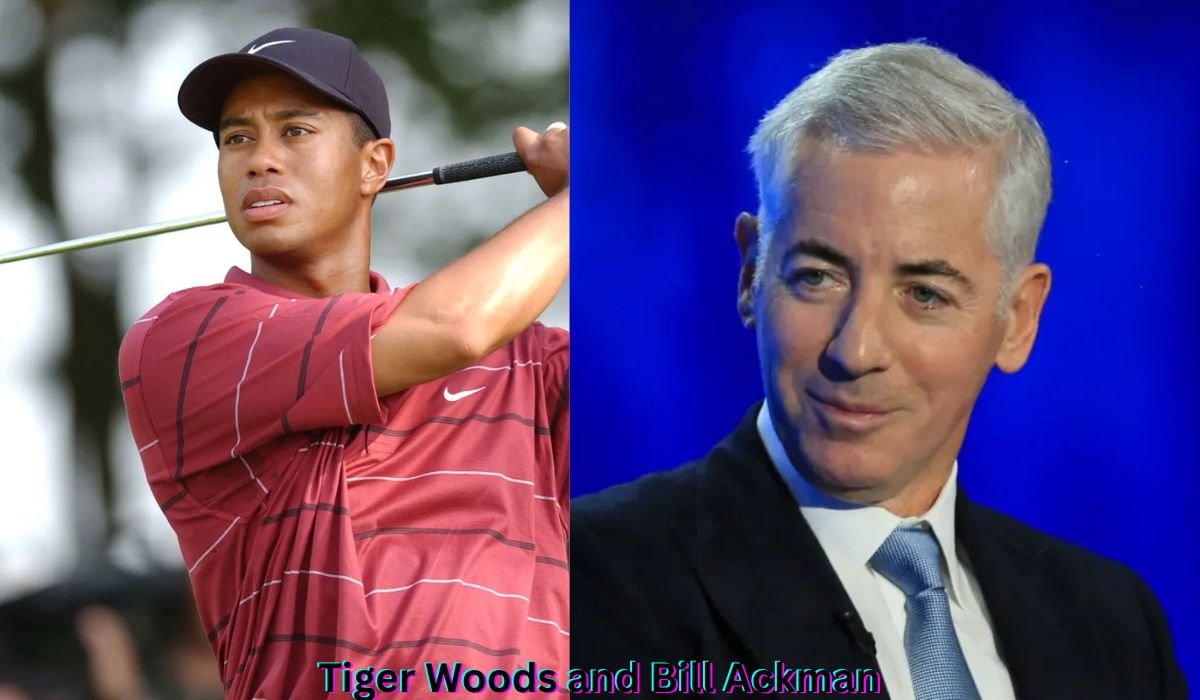
Tiger Woods and Bill Ackman built their names in completely different arenas, yet both offer powerful business insights for anyone curious about modern business architecture. One mastered professional golf and turned it into a global brand; the other mastered investment management and turned analysis into influence.
This article explores how Tiger Woods and Bill Ackman transformed personal expertise into lasting business ecosystems. Along the way, we’ll connect their strategies to cloud architecture, scalability, and security, showing how sports and finance surprisingly mirror smart digital transformation principles.
Who Are Tiger Woods and Bill Ackman?
Tiger Woods leads TGR, encompassing TGR Design, TGR Foundation, TGR Live, and The Woods Jupiter, alongside TMRW Sports and TGL. Bill Ackman founded Pershing Square in 2003, driving investment strategy, corporate strategy, and shareholder activism, with ties to Howard Hughes Holdings and the Pershing Square Foundation.
- Tiger Woods golf icon turned business ecosystem builder
- Bill Ackman investor shaping corporate governance nationwide
Tiger Woods: From Athlete to Business Ecosystem
Tiger Woods shows how a personal brand grows into a diversified platform spanning golf-course design, hospitality, philanthropy, and sports entertainment. Through TMRW Sports, he co-created TGL, blending indoor golf with technology-driven golf formats, proving sports innovation thrives when tradition meets bold digital reinvention.
- Golf-course design and event ventures
- TGL: technology-driven golf meets sports entertainment
Bill Ackman: Investment Strategy as a Business Architecture
Bill Ackman’s approach centers on capital allocation, spotting investment opportunities, and shaping corporate governance through Pershing Square. His model resembles centralized cloud architecture, shared centralized governance and centralized strategy supporting independent operating units, much like enterprises balancing oversight with specialized, autonomous teams.
- Capital allocation across diverse holdings
- Centralized governance enabling specialized execution
Tiger Woods and Bill Ackman: A Useful Business Comparison
Comparing Tiger Woods and Bill Ackman highlights contrasting yet complementary paths: one athlete-led business, the other investor-led business. Both demonstrate scalability, risk management, and brand strategy in action, proving that consumer-facing business models and institutional business models can each build lasting value differently.
| Dimension | Tiger Woods | Bill Ackman |
| Core Strength | Professional golf, global brand | Investment management, analysis |
| Expansion | Hospitality, philanthropy, sports technology | Corporate strategy, foundations |
| Risk Focus | Brand risk, partnership risk | Market risk, operational risk |
| Strategy Type | Athlete-led business | Investor-led business |
What Their Careers Teach Us About Cloud Architecture
Both careers mirror cloud infrastructure principles: a strong core supporting flexible extensions. A sports enterprise might run customer-facing applications, mobile applications, and an analytics platform atop shared identity service and databases, echoing how digital business platforms scale without duplicating foundational systems.
| Business Function | Cloud Equivalent |
| Brand & Governance | Identity Management, Centralized Governance |
| Customer Experience | Customer-Facing Applications, Mobile Applications |
| Data & Insights | Analytics Platform, Databases |
Scalability: Building for Growth Without Rebuilding Everything
Scalability matters whether hosting a golf tournament or scaling investment capital. Load balancing, auto-scaling, and content delivery networks handle surging digital users, just as TGL’s format proves digital infrastructure must expand smoothly alongside business expansion and rising audience demand.
- Auto-scaling and load balancing manage traffic spikes
- Content delivery networks keep digital infrastructure responsive
Security and Risk Management
Strong cybersecurity protects both financial and sports platforms. Encryption, network segmentation, access management, and continuous monitoring safeguard payment data, employee records, and proprietary content. Financial firms face heightened regulatory considerations, while sports organizations protect confidentiality across growing digital touchpoints.
| Security Layer | Purpose |
| Identity Management | Controls access management |
| Encryption | Protects payment data |
| Incident Response | Handles backups, recovery |
Cost Considerations and Operational Efficiency
Cloud costs rise without discipline. FinOps practices track technology spending, resource utilization, and cloud budgets, choosing efficient storage tiers. Businesses inspired by Tiger Woods and Bill Ackman must measure operational efficiency against real returns, not expansion for its own sake.
- FinOps monitors technology spending continuously
- Storage tiers optimize cloud budgets wisely
Practical Use Cases for a Modern Sports Business
A modern sports business could launch a fan engagement platform featuring player information, video content, statistics, and personalized notifications. A centralized data platform linking ticketing systems and social channels enables machine learning to power smarter content recommendations.
- Fan engagement platform with personalized notifications
- Centralized data platform feeding machine learning insights
Read Also This: Troozer com Review: What the Website Is and What to Know
Future Trends: Sports, Finance, and Intelligent Digital Platforms

Connected data platforms, automation, edge computing, and advanced analytics will define modern investment platforms and sports alike. Expect immersive fan experiences, real-time statistics, and intelligent software reshaping operational reporting, while portfolio monitoring and financial analysis grow increasingly data-driven and automated.
- Edge computing enables real-time statistics
- Intelligent software transforms portfolio monitoring
Frequently Asked Questions
What connects these two famous business figures?
Tiger Woods and Bill Ackman come from different fields but both built strong professional brands. Their careers show how expertise can create wider business influence.
What is Tiger Woods known for outside golf?
Tiger Woods and Bill Ackman have expanded beyond their main careers. Woods has developed interests in business, design, hospitality, philanthropy, and sports-related ventures.
What does Bill Ackman do professionally?
Tiger Woods and Bill Ackman represent different industries. Ackman is known for investment management, corporate strategy, and his role as a prominent investor.
Are these two men business partners?
There is no widely documented business partnership between Tiger Woods and Bill Ackman. Their professional paths have mainly developed separately across different industries.
How did Tiger Woods build his business influence?
Tiger Woods and Bill Ackman show different paths to business influence. Woods used his sports success to develop brands, ventures, investments, and partnerships.
How did Bill Ackman build his professional reputation?
Tiger Woods and Bill Ackman achieved recognition through different careers. Ackman built his reputation through investing, financial analysis, corporate campaigns, and strategic decisions.
Why are these two professionals compared?
Tiger Woods and Bill Ackman may attract interest because both turned professional expertise into broader business influence. Their careers offer different examples of brand building.
Final Thoughts
Tiger Woods and Bill Ackman prove that governance, leadership, and reliable data matter more than the industry itself. Their journeys from personal expertise to expansive business ecosystems offer a practical blueprint for anyone building scalable, secure, and future-ready ventures today.
Ultimately, Tiger Woods and Bill Ackman remind us that financial discipline and customer value outlast any single trend. Whether through golf or investing, lasting success depends on strong foundations, smart digital transformation, and consistent, principled execution over time.